Why reading aloud after age 8 still works
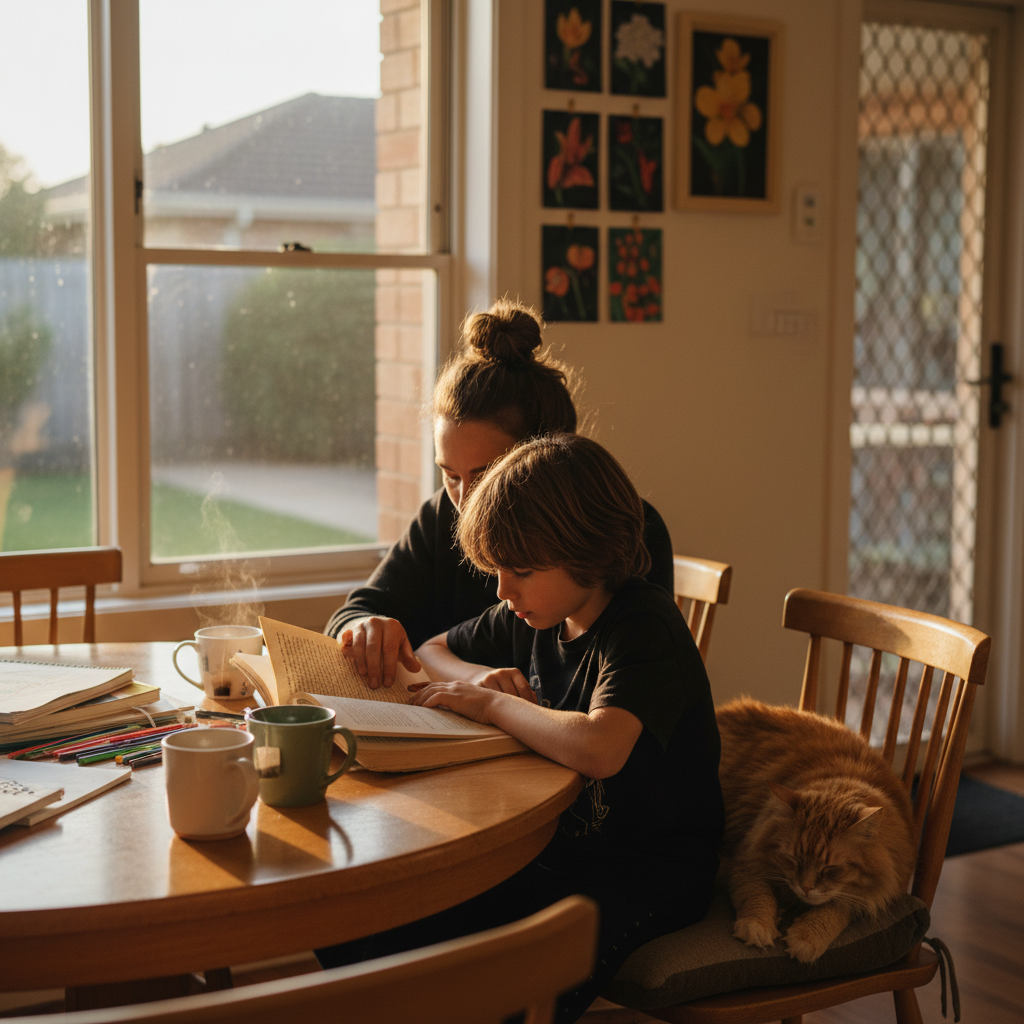
My nine-year-old was telling me about a book he was reading, and he casually dropped the word "epitome." Only, he pronounced it "epi-tome." It’s a classic reader’s mistake—the kind of error you only make when you’re pushing yourself into harder books but not hearing the words spoken out loud. I corrected him gently, he rolled his eyes at me, and we moved on.
But it made me realise something: we hadn't read a book together in six months. Somewhere around year 4, when he became a fluent independent reader, our bedtime read-alouds just quietly faded out. I thought my job was done. He could read on his own, so why would I keep reading to him?
The Independence Trap
In Australian primary schools, there’s a massive shift around year 3 and 4. The focus moves from learning to read, to reading to learn. Suddenly, the school newsletter is asking for 20 minutes of "independent reading" each night. As a tired parent, this is a glorious milestone. You finally get that 20 minutes back to load the dishwasher, pack lunchboxes, or just stare blankly at the wall.
But the consequence of this independence is that we stop reading aloud to our kids precisely when the books get really interesting. There’s a quiet gap that opens up for an 8, 9, or 10-year-old. Their reading level—what they can actually decode on a page—is almost always lower than their listening level—what they can comprehend when a fluent adult reads it with expression.
By stopping the read-alouds, we accidentally cap their exposure to complex plots, historical contexts, and advanced vocabulary. We leave them alone with words like "melancholy," "bureaucracy," or "epitome," without the safety net of our tone of voice to explain the meaning. The push for independence, while necessary, leaves a lot of rich language on the table.
Reading "Up" in 2026
So, how are teachers and parents bridging this gap in 2026? They’re reading "up." They are purposely picking books that are one or two years above the child's independent reading level. If your year 5 child is happily tearing through Diary of a Wimpy Kid on their own, that’s fantastic. Let them. But for the shared read-aloud, you pick up a meatier fantasy novel, a classic, or a compelling non-fiction book about space exploration.
I spoke to a year 6 teacher in Melbourne recently who said her absolute non-negotiable for classroom engagement is a 15-minute read-aloud after lunch. No questions, no whiteboards, just her reading a cracking good story. She models how to tackle tricky pacing and how to inject emotion into dialogue. The kids who hate reading are just as captivated as the bookworms.
At home, this often looks like the "hybrid approach." You read a chapter while they eat afternoon tea. Or you listen to a high-quality audiobook in the car on the way to footy training, pausing occasionally to ask, "Wait, why on earth did the main character just do that?"
If you’re unsure exactly where your child’s reading comprehension is actually sitting compared to their peers, it can be hard to know which books to pick. That's where a free diagnostic from BrightPath can be handy to give you a baseline. But honestly, the exact reading level matters less than the exposure. The goal is simply to let them hear the rhythm of complex sentences.
The 3-Gear Read-Aloud Strategy
If you want to bring reading aloud back into your house for an older kid, it helps to think about it using three gears.
Gear 1: The Heavy Lifting (You read). This is for the rich, complex texts. You do 100% of the reading. You are the engine. You pause naturally when a word is weird. "He was entirely nonplussed... do you know what nonplussed means? Yeah, me neither, let's look at the sentence. Oh, it means he's confused." You are modelling how smart adults deal with not knowing things.
Gear 2: The Shared Load (You alternate). This works brilliantly for dialogue-heavy books or plays. "I’ll read the narrator and the adults, you read the main character." It keeps them engaged without exhausting their decoding muscles. It turns a reading chore into a script-reading session. It’s highly social and surprisingly fun.
Gear 3: The Audiobook Outsourcing (Someone else reads). Let’s be real, by 8pm on a Thursday, your voice might be entirely gone. High-quality audiobooks narrated by professional actors are not cheating. They are incredible tools for exposing kids to fluent, expressive reading. Put one on a speaker while they build Lego or draw. It absolutely counts.
Where It Goes Wrong
Where does this fall apart? Usually, it's when we accidentally turn a nice moment into a pop quiz. If you stop every single paragraph to ask, "Now, what is the main idea here?" or "Can you identify the adjective in that sentence?", your 10-year-old will suddenly remember they have pressing chores to do in their room. Reading aloud works because it’s a shared narrative experience, not NAPLAN prep.
The other trap is picking a "worthy" classic that is actually incredibly boring to a modern kid. If you try to force-feed them a dense 19th-century novel because you heard it's "good for their vocabulary," and you're both miserable by page ten, just drop the book. There is no prize for finishing a story you both hate. Move on to a gripping middle-grade mystery or a biography of someone they actually care about.
And finally, there's the teenager pushback. Around 12 or 13, they genuinely might not want you reading to them anymore. That's fine. Don't force it. Pivot to reading the same book independently and just talking about it over dinner.
The Quiet Win
Here’s the quiet win of reading aloud to older kids: it creates a neutral zone. When an 11-year-old is dealing with friendship drama, shifting hormones, and the increasing academic pressure of upper primary, sitting side-by-side while an adult reads a story is a rare moment of low-stakes connection. They don't have to perform. They don't have to prove they understand the maths homework. They just get to listen. It gently rebuilds the bridge that the necessary push for independence sometimes strains.
Your one thing to try this week: Don't announce a "new reading program" to your child. Just grab a book you think looks genuinely interesting, leave it on the kitchen bench, and while they are eating an after-school snack, say, "I started reading this today, listen to this first page." Read one page out loud. If they lean in, keep going. If they don't, leave it there and try again next week.
Curious where your child is strong — and where the gaps are?
Take BrightPath's free 20-minute diagnostic, aligned to the Australian Curriculum v9.
Start the Free Diagnostic