How Much Sleep Does a Year 6 Student Actually Need?
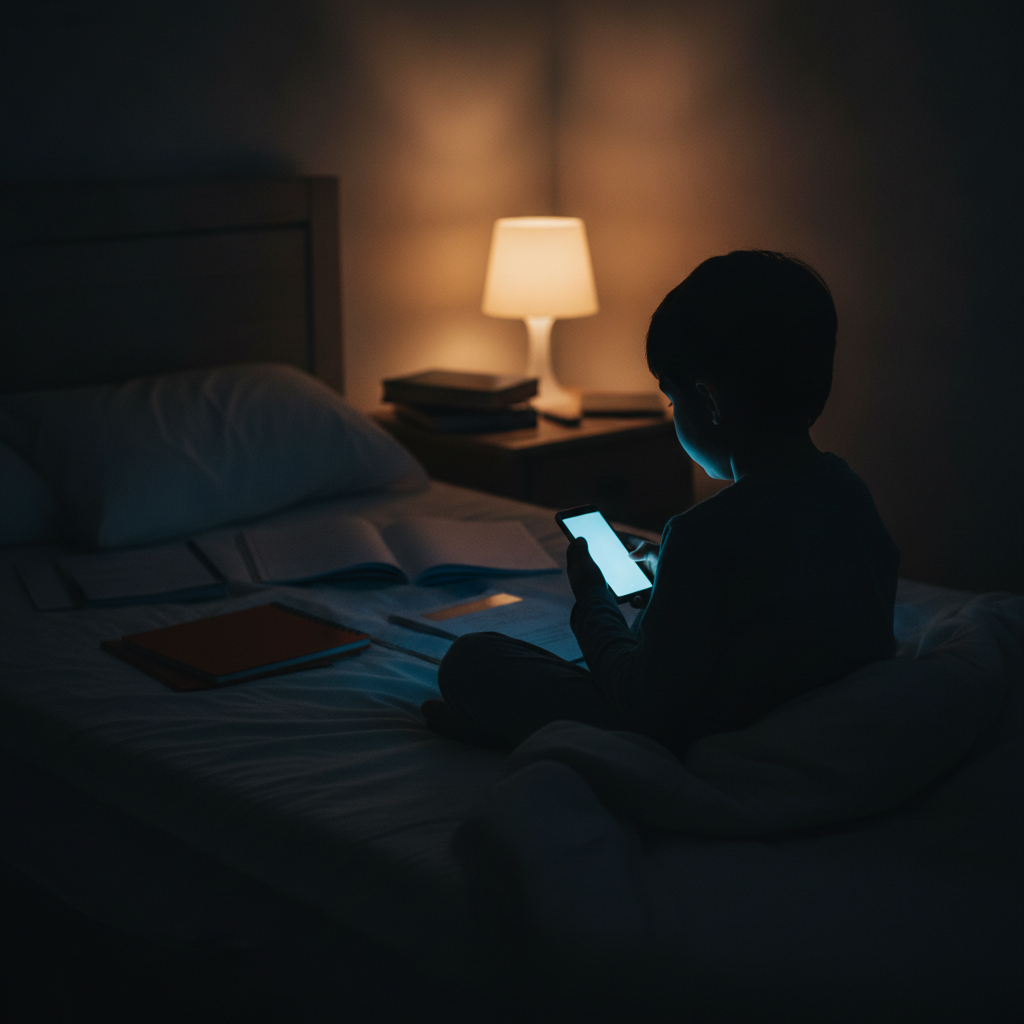
A Year 6 student needs 9 to 11 hours of sleep a night, and the research consensus — backed by the Sleep Health Foundation Australia and the Raising Children Network — is that most Australian ten and eleven-year-olds are getting closer to 8. That gap doesn't show up as yawning at the breakfast table. It shows up at 4:30pm, when a kid who could multiply fractions on Tuesday is suddenly in tears over the same worksheet on Thursday, insisting they "never learned this."
My neighbour texted me about exactly this a few weeks ago. Her son Leo, eleven, had been fine with maths all year, then started melting down over homework that used to take fifteen minutes. Fine with the concept on a good day, hopeless on a bad one. She assumed it was the content getting harder. It wasn't. It was a two-week stretch of falling asleep with his iPad at 10:30 instead of lights-out at 8:30.
It's Not Tiredness — It's This
Parents and teachers are pretty good at spotting tired. Droopy eyes, slow to get moving, asking to lie on the couch. What's harder to spot is sleep-deprived, because it doesn't look tired at all — it looks like a behaviour problem or a learning gap.
A sleep-deprived Year 6 kid is often irritable in a way that seems disproportionate: crying over a dropped pencil, snapping at a sibling for existing in the same room. They struggle to recall things they clearly knew — not because the knowledge is gone, but because sleep is when the brain files short-term memory into long-term storage, and that filing didn't happen properly overnight. And they process instructions slower: a two-step direction like "get your maths book and open it to page 12" takes visibly longer to land, and needs repeating.
None of that looks like "needs more sleep" from the outside. It looks like attitude, or a kid who's suddenly behind. Teachers see it constantly and often can't say anything, because they only see the symptom, not the 10:47pm bedtime that caused it.
What's Actually Working: The Numbers and the One Rule
The Sleep Health Foundation Australia's guidelines, echoed by the Raising Children Network, break down like this: kids aged 5 to 12 need 9 to 11 hours; teenagers need 8 to 10. For a Year 6 student specifically, that means if school starts at 8:45am and they're up by 7am, lights-out needs to happen by around 8:30 to 9pm — not "in bed by 9," actually asleep.
Families who are getting traction with this aren't doing anything exotic. The ones I hear about most are using a hard screen cutoff — devices off (not just face-down) 60 minutes before lights-out — and a wind-down routine that doesn't change night to night: shower, read ten pages, lights off. The consistency matters more than the specific activities. A rotating cast of "whatever keeps them calm tonight" doesn't give the brain the same cue.
On screens specifically: Australian sleep researchers have flagged two separate problems, not one. Blue light delays the release of melatonin, the hormone that makes you sleepy. But the content matters just as much — a fast-cutting YouTube video or a group chat is arousing in a way that keeps the brain alert regardless of the light involved. A kid reading a book on a dimmed tablet is a different problem than a kid watching gaming videos on a phone. Treating "screens" as one category misses this.
The Three Tells
If you're trying to work out whether a rough patch is sleep, a genuine skill gap, or something else, watch for three things over a week, not one bad day:
Irritability out of proportion — reactions to small frustrations that are bigger than the frustration warrants.
Recall that comes and goes — a kid who "gets" a concept one day and seems to have never seen it the next, on material that hasn't changed.
Slower processing on multi-step tasks — following two or three instructions in a row takes noticeably longer, or needs repeating.
One of these on one bad day is nothing. All three showing up together across a week, especially paired with a late bedtime pattern, is a sleep problem wearing a homework costume — not a maths problem. If you want a clearer read on whether it's sleep, a skill gap, or something else entirely, BrightPath's Free Diagnostic is a decent twenty-minute way to separate those threads before you overhaul a routine for the wrong reason.
Where This Goes Wrong
The failure mode I see most isn't ignorance — it's over-scheduling. Swimming squad at 6am, after-school tutoring, homework, then a screen as the only downtime left in the day, pushed later and later because it's the sole slot where the kid gets to just switch off. Nobody chose to sacrifice sleep; it just lost every time to something that looked more important in the moment.
The second failure mode is weekend catch-up sleep — letting a Year 6 kid sleep until 10am Saturday and Sunday to "pay back" the week's debt. It feels compassionate. It also shifts their body clock by two hours, which functions like flying interstate and back every weekend, and makes Monday morning genuinely harder, not easier.
The Quiet Win
The single change that moves the needle most for a Year 6 kid's concentration isn't a stricter bedtime — it's a fixed wake-up time, seven days a week, within thirty minutes. A consistent wake time anchors the body clock in a way a consistent bedtime alone doesn't, and it's the lever behind most of the "we fixed sleep and homework got easier" stories parents tell.
Try it for one week: same wake-up time Saturday and Sunday as school days, even if bedtime wobbles a little. It's a smaller ask than a full routine overhaul, and it's usually the first thing that makes the 4:30pm meltdowns quieter.
Curious where your child is strong — and where the gaps are?
Take BrightPath's free 20-minute diagnostic, aligned to the Australian Curriculum v9.
Start the Free Diagnostic