My Kid Is Gifted — So Why Are They Struggling at School?
Your child might be twice-exceptional if they can explain black holes in detail but can't get through a spelling list without tears, if their teacher describes them as "clearly bright but not applying themselves," or if their report card reads like it was written about two different kids. Twice-exceptional — often shortened to "2e" — means genuinely gifted in some areas and genuinely struggling in others, at the same time, in the same kid.
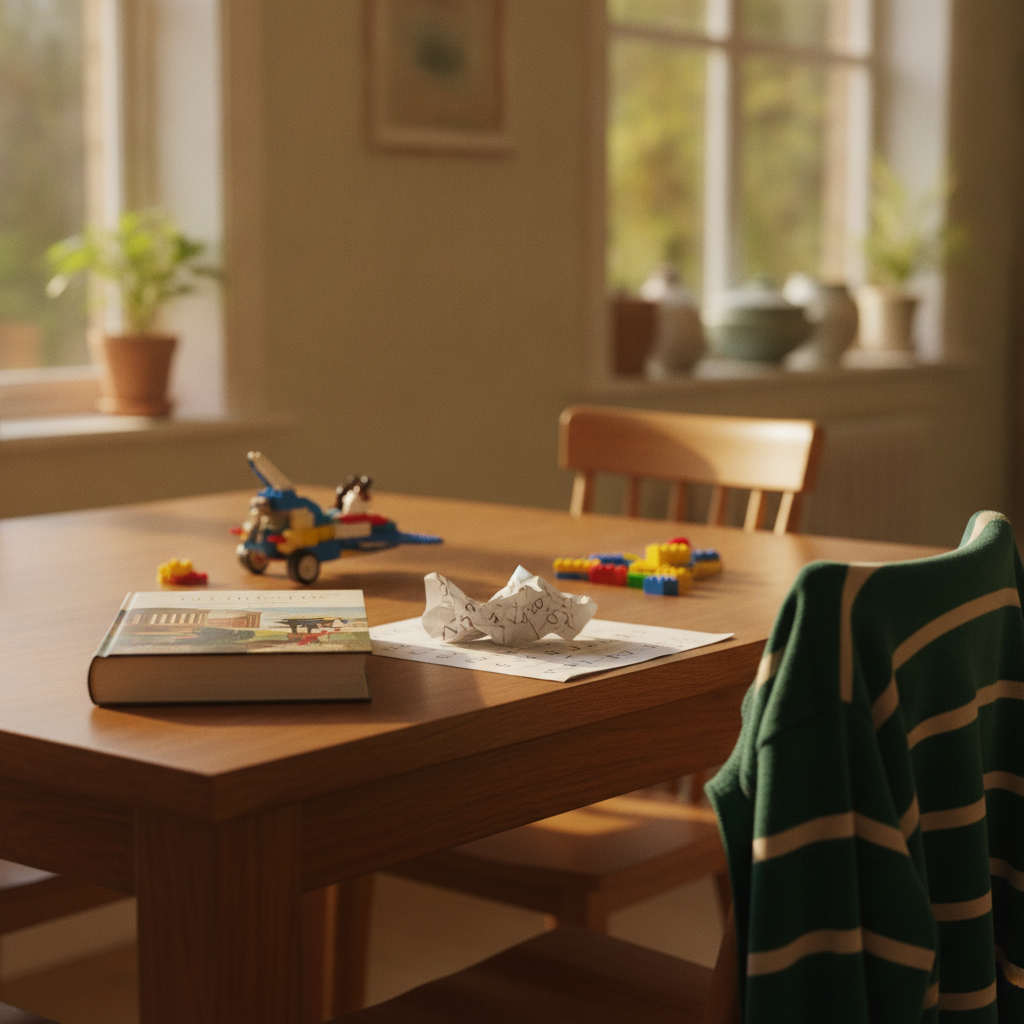
Nine-year-old Leo can tell you the entire order of Roman emperors and correct his dad's facts about the eruption of Vesuvius. He also cried at the kitchen table for forty minutes last Tuesday because he couldn't get his handwriting to "look right" for a one-paragraph recount. His mum told me she spent two years thinking he was lazy before a teacher, almost as an aside, said: "Have you ever wondered if he's twice-exceptional?" She hadn't heard the term before. Most parents haven't.
Why these kids slip through the cracks
Here's the mechanism, and it's almost unfair in how neatly it works against the kid: the giftedness hides the struggle, and the struggle hides the giftedness. A child who can hold a sophisticated conversation about the Ancient Egypt unit doesn't look like a child who needs help — so when their writing output is thin or their maths homework takes three times as long as it should, teachers assume it's a motivation problem, not a skills gap. Meanwhile, the struggle drags down the average enough that the giftedness never gets flagged either. The two cancel each other out on paper, and the kid ends up looking "solidly average" — which, for a child who's actually gifted in one area and genuinely finding another area hard, is the worst possible outcome. They get neither the extension nor the support.
It shows up differently by age. In Year 4 and 5, it often looks like a kid who dominates class discussion but hands in almost nothing written — the gap between what they can say and what they can put on paper is the tell. By Year 7 and 8, when the Australian Curriculum expects more independent organisation and multi-step written responses, that gap widens fast. A kid who was getting by on verbal smarts alone suddenly can't hide it, and teachers who've never seen the "gifted" side of them just see a student who's disorganised and behind.
What's actually helping families right now
The families who get traction tend to do three things. First, they stop treating "gifted" and "struggling" as a contradiction to resolve and start treating them as two separate facts to act on separately. Second, they go looking for a fuller picture rather than relying on one teacher's snapshot — report comments from three or four subjects over a couple of terms, read side by side, often reveal the pattern before any formal assessment does. A free tool like BrightPath's free diagnostic can be a useful starting point here too — it's not a clinical assessment, but seeing where a child is well ahead of year level in one area and behind in another, laid out plainly, is often what finally makes a parent's gut feeling concrete enough to raise with a teacher.
Third — and this is the one people underestimate — they ask for the strength to be used as the way in, not treated as a reward for fixing the weakness first. A Year 6 teacher I spoke with lets a maths-strong, writing-reluctant student do his working out and initial thinking in dot points and diagrams before he has to write full sentences. He's not avoiding the writing; he's approaching it from a direction that doesn't shut him down before he starts.
The Two-Column Test
Before a parent-teacher meeting, it helps to walk in with a simple two-column list: one column headed "runs ahead," the other "gets stuck." Not a diagnosis, just an honest inventory. Leo's might read: ahead — general knowledge, verbal reasoning, science concepts; stuck — handwriting output, starting written tasks, transitions between subjects. This does two things. It stops the conversation from collapsing into "is my child gifted or does my child need help" — a false choice — and it gives the teacher something specific and actionable rather than a vague "he's not reaching his potential." Bring it to the meeting, not just in your head. Teachers see forty report comments a term; a written list is far more likely to survive past the meeting and shape what actually happens in class.
Where good intentions go sideways
The most common misstep is loading a 2e kid up with extension work in their strong subject while leaving the struggle untouched, on the theory that success in one area will "build confidence" that spills over into the other. It rarely does — it just makes the gap between the two areas more visible and more painful for the kid. The opposite mistake is just as common: focusing so hard on remediation that the strength goes completely unfed for a year or two, and a kid who used to light up about astronomy stops mentioning it, because school has quietly become the place where only the hard stuff gets attention. Both are well-meaning. Neither works.
The quiet win
Leo's mum told me the shift wasn't a program or a plan — it was his teacher letting him research Roman emperors for ten minutes at the start of writing time, most days, before asking him to write anything at all. He wasn't being fixed. He was being recognised as capable and stuck, both true, in the same forty minutes. This week, try building your own two-column list for your child — five minutes, no expert required — and bring it to the next thing that looks like it might be a parent-teacher chat.
Curious where your child is strong — and where the gaps are?
Take BrightPath's free 20-minute diagnostic, aligned to the Australian Curriculum v9.
Start the Free Diagnostic