Does My Kid Need a Quiet, Tidy Desk to Do Homework?
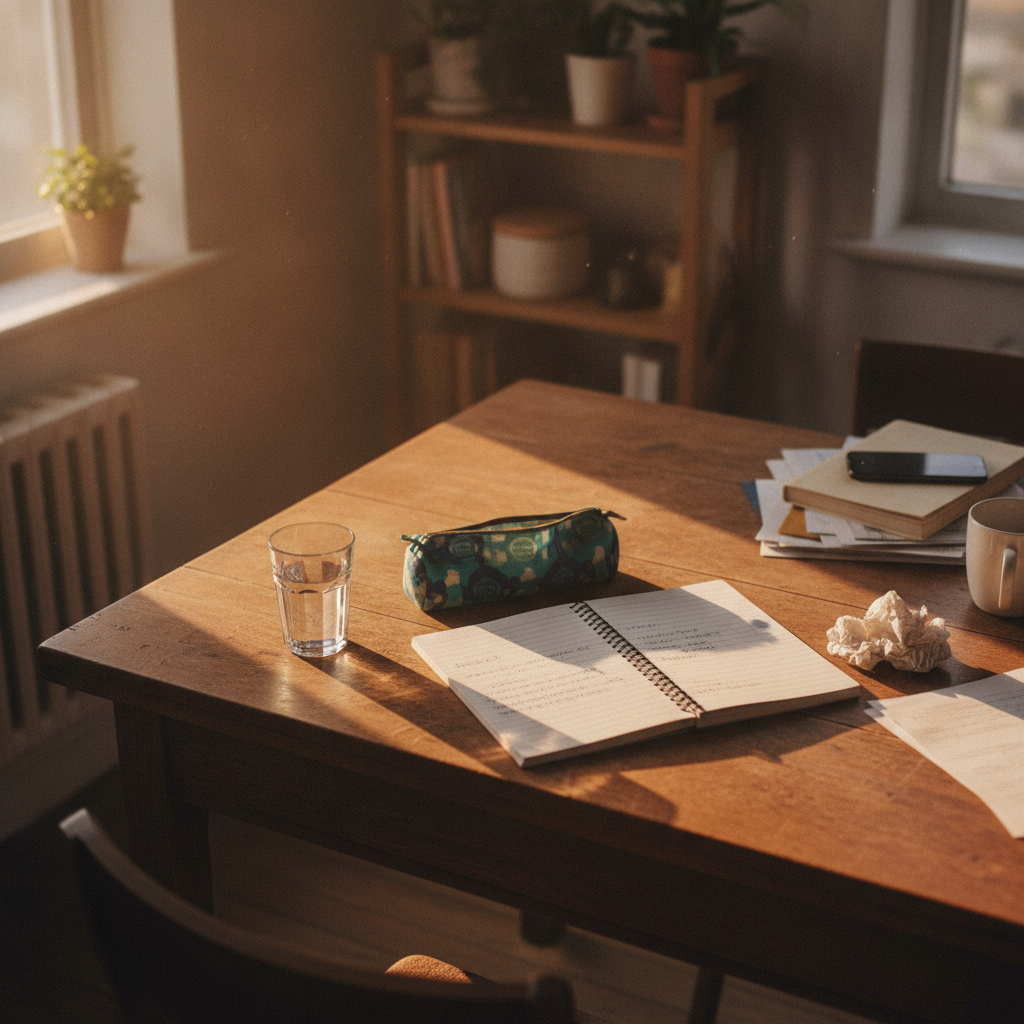
Desk tidiness and mood lighting have almost nothing to do with whether your kid actually finishes their homework — what matters is background noise level, how often they're switching between tasks (or apps), and how close their phone is sitting to their hand. My neighbour spent a weekend building her year-8 son a "proper study nook" — new lamp, corkboard, matching stationery — and within two weeks he was back at the kitchen table, because the nook was in his bedroom next to his phone charger and the kitchen table was next to her. She'd fixed the wrong variable.
It's an easy mistake to make, because a tidy desk *feels* like progress. You can see it. You can photograph it for the family group chat. But none of it touches the thing that actually derails a 20-minute maths worksheet: a notification lighting up mid-sentence, or a sibling's TV bleeding through a thin wall.
The real tension: we fix what we can see, not what's breaking focus
Most homes don't have a spare study room, and most parents know it — so the guilt lands on the wrong target. Pinterest-perfect homework corners suggest that if your child is struggling, it's because the environment isn't "set up properly." That's rarely true. The bigger issue in 2026 is that kids do homework in the same physical inch of space where they also game, text friends, and watch clips — often on the same device the homework is meant to be typed into.
Task-switching is the quiet killer here. A 2018 University of California study (and plenty of replications since) found it can take over 20 minutes to fully refocus after an interruption — not because kids are undisciplined, but because attention genuinely doesn't snap back instantly. A "quick check" of a group chat mid-fractions problem isn't a five-second cost. It's closer to a twenty-minute one, repeated three or four times an evening.
What's actually working
Families who've made real headway aren't buying furniture — they're changing three specific things:
Phone out of arm's reach, not just face-down. Face-down on the same table still buzzes, still glows at the edge of vision. Parents who report the biggest shift put the phone in another room, or in a charging spot near the parent, for the homework block. Not confiscated forever — just physically absent for 30 minutes.
Noise that's steady, not stimulating. A 2019 review in the journal Psychology of Music found that lyrics and unpredictable sound (a sibling's YouTube video, a TV in another room) hurt performance on reading and writing tasks specifically — the brain can't help processing words it hears while trying to produce words on the page. Steady, low, non-lyrical sound (a fan, white noise, instrumental music) didn't show the same cost, and some kids concentrate better with it than in dead silence, especially in a busy household. Maths and rote practice seem less sensitive to this than reading or essay writing.
One task open at a time. Not one tab — one task. If your child is doing a worksheet, having the browser open "just for looking things up" is often where 15 minutes disappears into an unrelated search. Tools that isolate one problem at a time (including how we structure sessions at BrightPath) tend to hold attention better than a general-purpose device with everything available.
If you're not sure which of these is actually your child's blocker — noise, phone habits, or something more foundational like a maths gap making every session painful — a Free Diagnostic can help separate "environment problem" from "skill gap" in about 15 minutes, which saves you guessing for a term.
The mental model: the three questions that actually predict focus
Before rearranging furniture, ask three questions about the homework spot, in this order:
1. Can a notification reach them? If a phone, tablet, or gaming console can light up or buzz within their eyeline during the session, this is the first thing to fix — before anything else on this list.
2. Is the sound predictable? Steady background hum (dishwasher, fan, instrumental music) is usually fine or even helpful. Unpredictable sound with words in it (siblings talking, TV dialogue, someone's phone call) is the one that actually costs focus, particularly for reading and writing.
3. Is there one task or five? A single worksheet and a pencil beats a laptop with six tabs "for reference," even if the laptop looks more organised.
Desk tidiness and lighting don't make this list — not because they're irrelevant to comfort, but because they don't move the needle on whether the work gets done. If those three checks pass on a cluttered kitchen table, the cluttered kitchen table is fine.
Honest failure modes
Some well-meaning fixes backfire. Noise-cancelling headphones playing a "focus playlist" often turn into a portable entertainment system the moment the parent leaves the room — the playlist becomes a excuse to have earbuds in, and earbuds become a gateway to messages. Total silence, pushed as the ideal, can also misfire: some kids (often ones who fidget or talk to themselves while working) find dead silence more distracting than a low hum, because every small sound becomes noticeable. And the "everyone must work at a desk" rule ignores that some kids genuinely focus better cross-legged on the floor or at the kitchen table where a parent is nearby — proximity to a calm adult, not desk ergonomics, is doing the work there.
The quiet win, and one thing to try this week
The kids who cope best with homework in small, noisy houses aren't the ones with the nicest setup — they're the ones whose parents removed one specific distraction consistently, every night, rather than redesigning the whole room once. Consistency beats aesthetics.
This week, try just one change: for the next homework session, put your child's phone (and yours, if it's nearby) in a different room entirely, and see how the session goes without touching anything else — same messy table, same background noise. That single 30-minute test will tell you more about what's actually stalling homework than any amount of tidying will.
Curious where your child is strong — and where the gaps are?
Take BrightPath's free 20-minute diagnostic, aligned to the Australian Curriculum v9.
Start the Free Diagnostic