Flashcards, Apps or Worksheets: Which One Actually Works?
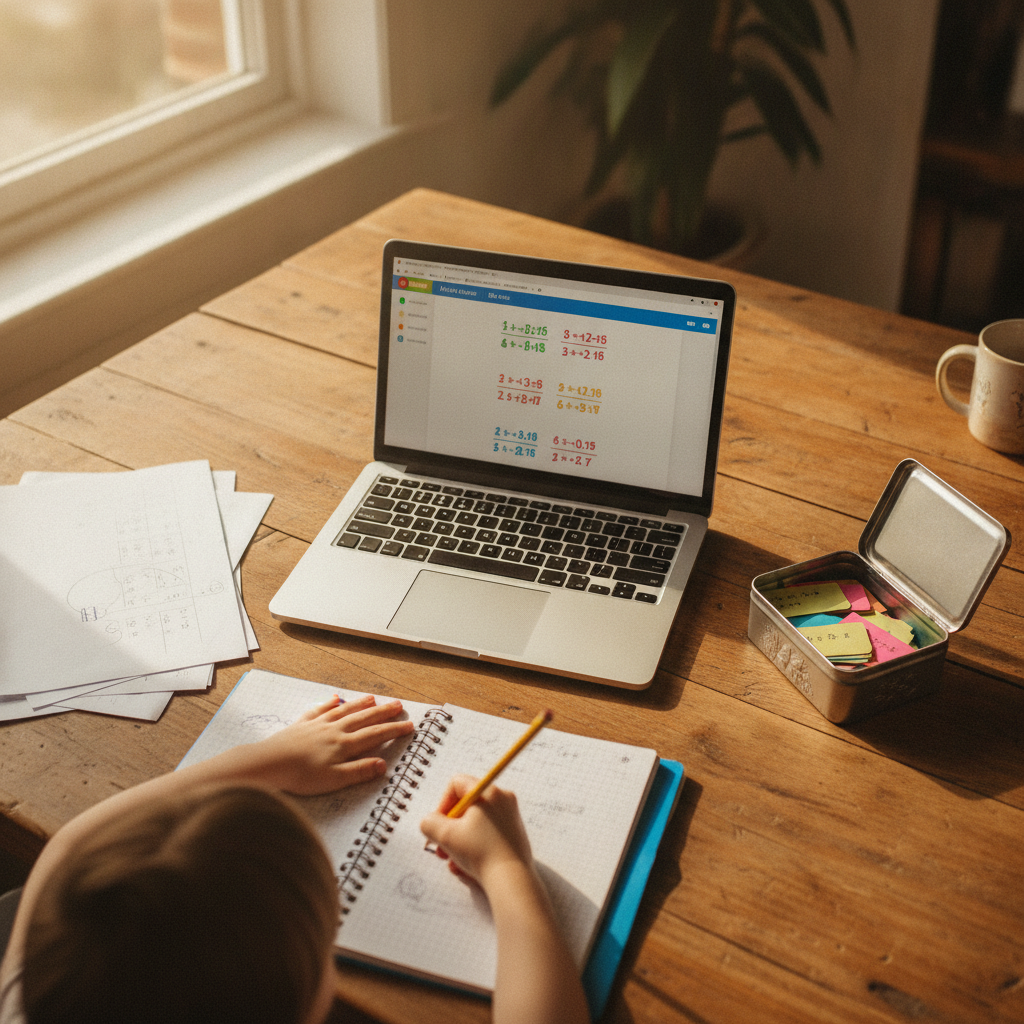
My neighbour's son, Ethan, is 13 and doing Year 8 science on the Australian Curriculum. Last term he had two things due in the same week: memorising the names of the eleven body systems, and writing a paragraph explaining why vaccines work. His mum bought him a flashcard app for both. It worked brilliantly for the body systems and did almost nothing for the vaccine question — he could recite "acquired immunity" but couldn't explain it in his own words. That's not a motivation problem or a "visual learner" problem. It's a tool-mismatch problem: flashcards are built for recall, not for understanding, and no amount of swiping fixes that.
The idea that kids learn best through their personal "learning style" — visual, auditory, kinaesthetic — has been tested repeatedly by cognitive scientists and hasn't held up. What actually predicts whether a study method works is the type of task in front of the kid: is it a fact to remember, a procedure to execute, or a concept to understand. Match the method to the task, and even a "bad at maths" kid starts looking pretty capable.
The real tension: everyone defaults to one tool for everything
Here's what actually goes wrong in most households and classrooms: families and teachers pick one method and hammer every subject with it. The flashcard family flashcards everything, including long division, which is a procedure, not a fact — so the cards just teach "7 × 8 = 56" without building the actual skill of carrying digits and checking remainders. The worksheet family drills pages of algebra problems for a kid who's shaky on why you can do the same thing to both sides of an equation, so they get faster at a method they don't trust. The app family assumes that because Khan Academy has slick videos, watching one counts as learning — until test day reveals the kid can follow along but can't start from a blank page.
None of these families are lazy or wrong to try. The tools genuinely work — just not for whatever they're being pointed at. A NAPLAN numeracy question and a Year 10 essay on symbolism require completely different kinds of practice, and most home study time is spent using the wrong tool for the job because it's the one already sitting on the table.
What's actually working right now
Three tools, three jobs, done properly:
Flashcards (Anki, or literally index cards) for pure recall. Times tables, chemical symbols, French vocab, historical dates, the quadratic formula itself (not how to use it — just recalling it exists and what it says). Anki is free, works on phone and desktop, and its spaced-repetition algorithm is genuinely well-researched — it resurfaces a card right before you're about to forget it. For a Year 5 or 6 kid still shaky on times tables, five minutes a day beats an hour of worksheets. For a Year 11 doing HSC or VCE content with genuine memorisation load (biology terminology, historical dates), it's excellent. It's a poor fit for anything requiring judgement or multi-step reasoning.
Worked examples and worksheets (pen-and-paper, or Khan Academy's practice sets) for procedure. Long division, solving for x, balancing equations, grammar rules applied in a sentence — anything with a repeatable sequence of steps benefits from seeing the steps done correctly first, then doing them yourself, by hand, with working shown. This is where Khan Academy earns its keep: it's free, covers the Australian Curriculum reasonably well from Year 3 up, and its "watch a worked example, then try one" structure is exactly the sequence procedural learning needs. The catch is that watching isn't the same as doing — a kid needs to attempt the problem with the video paused, not just nod along.
Elaborative interrogation for concepts. That's a clunky term for a simple thing: asking "why" and "how do you know" and making the kid answer out loud or in writing, in their own words, with no notes. Why does dividing by a fraction flip it upside down? Why did the character make that choice? This is the one flashcards and apps are worst at, because it can't be scripted into a right/wrong answer — it needs a person (parent, tutor, or the kid explaining to a sibling) pushing back with "okay, but why."
If you're not sure which bucket your child's actual gaps fall into — recall, procedure, or concept — a proper diagnostic is faster than guessing. BrightPath's Free Diagnostic breaks down exactly where the gaps are by task type rather than just topic, which saves weeks of drilling the wrong thing.
The mental model: the Recall-Procedure-Concept test
Before opening any app or workbook, ask one question about the specific thing your child is stuck on: is this a fact, a process, or an idea?
1. Fact ("what is it called / what does it equal") → flashcards, spaced repetition, five minutes a day, no explanation needed.
2. Process ("what are the steps, in order") → worked example first, then a worksheet with working shown, checked by someone who can catch a wrong step, not just a wrong answer.
3. Idea ("why does this work / what does this mean") → talk it through. Get the kid to explain it back, teach it to a younger sibling, or write one paragraph with no notes. If they can't, that's the actual gap — not lack of practice.
4. Mixed task (most real homework) → do them in that order. Recall the facts first, walk through the procedure second, and only then ask the "why" question — trying to explain a concept before the basic facts are solid just produces confident nonsense.
Where this goes wrong
The most common failure I've seen: a flashcard app that quietly turns into a reward-loop toy. Kids chase streaks and badges instead of actually retrieving the answer from memory — they peek, or guess fast to keep the animation going. If your child is "doing flashcards" for 40 minutes and their actual test scores aren't moving, check whether they're recalling or just tapping.
The second failure is over-scheduling all three methods for every subject "to be thorough," which just burns out an already tired kid doing two hours of maths on top of a full school day. And the third is worksheets used as a proxy for effort — a stack of completed pages feels like progress, but if every answer was copied from a worked example without the kid attempting it cold first, the pile is decoration, not learning.
The quiet win
The kids who improve fastest aren't the ones with the most study apps — they're the ones whose parent or tutor asks "is this something you need to remember, do, or understand" before picking up any tool at all. That one question, asked consistently, does more than any app subscription.
This week, try it just once: next time your child is stuck on homework, before opening anything, ask them to name whether it's a fact, a process, or a "why" question — then pick the matching tool from above. Twenty minutes, no new subscriptions required.
Curious where your child is strong — and where the gaps are?
Take BrightPath's free 20-minute diagnostic, aligned to the Australian Curriculum v9.
Start the Free Diagnostic